
Density is one of the fundamental physical properties used to evaluate the quality, purity, and composition of materials. Whether in plastics, rubber, textiles, chemicals, or food products, density gives critical insights into material structure and performance.
To measure this accurately and consistently, industries use a device called a Densimeter.
📘 What Is a Densimeter?
A Densimeter (or density meter) is an instrument used to measure the density or specific gravity of materials. Depending on the model, a densimeter can test solids, liquids, foams, rubber, plastic pellets, films, and composite materials.
Density = Mass ÷ Volume
The device simplifies this calculation using standardized methods such as Archimedes’ Principle.
🧪 Why Density Measurement Is Important
Density influences a material’s:
- Strength and durability
- Buoyancy characteristics
- Purity and composition
- Performance under stress
- Chemical concentration
- Material identification
Even small differences in density can lead to major variations in product quality, making density testing essential in quality control and R&D environments.
🔧 Types of Densimeters
Different industries use different types of densimeters:
1️⃣ Solid Density Densimeter (Archimedes Method)
Used for plastics, rubber, films, ceramics, pellets, and small solid components.
Sample is weighed in air and water to calculate specific gravity.
2️⃣ Liquid Density Meter
Often used in chemical, pharmaceutical, food, and beverage industries.
Includes oscillating U-tube and hydrometer-based instruments.
3️⃣ Foam Density Tester
Used for flexible and rigid foam density analysis. Common in packaging, insulation, cushion, and automotive foam.
🧫 How a Densimeter Works (Solid Density Example)
Most solid densimeters follow Archimedes’ Principle:
Weigh the sample in air (A).
Weigh the sample while submerged in water (B).
The densimeter automatically calculates density:
Density = A / (A – B)
This method is extremely accurate and widely accepted in quality control labs.
🏭 Industries That Use Densimeters
Densimeters are common in:
- Plastic & Polymer Manufacturing
- Rubber Industries
- Textile Fiber Testing
- Automotive & Aerospace Components
- Chemical & Pharmaceutical Plants
- Food & Beverage
- Composite Material Production
- Academic laboratories & R&D centers
In plastic and rubber testing alone, density helps determine polymer grade, filler content, and material consistency.
📦 Applications of Density Testing
✔️ Material Identification
Different grades of plastic (e.g., PP vs. PE) have distinct density ranges.
✔️ Detecting Filler or Additive Levels
Higher density may indicate more fillers such as calcium carbonate or glass fibers.
✔️ Quality Control of Raw Materials
Ensures suppliers meet specifications.
✔️ Purity Check for Liquids
Detects contamination or improper mixing.
✔️ Foam Quality Evaluation
Verifies the firmness and structure of foam products.
📐 Standards for Density Testing
Densimeter tests typically comply with:
- ASTM D792 – Density of plastics
- ISO 1183 – Determination of density for non-cellular plastics
- ASTM D3574 – Foam density
- ASTM D6772 – Liquid density
- DIN, JIS, and other industry standards
Following these ensures internationally accepted, repeatable results.
⭐ Conclusion
A Densimeter is an essential laboratory instrument for accurately determining the density of solids, liquids, and foams. It provides reliable data that supports material identification, quality control, formulation, and performance evaluation across multiple industries.
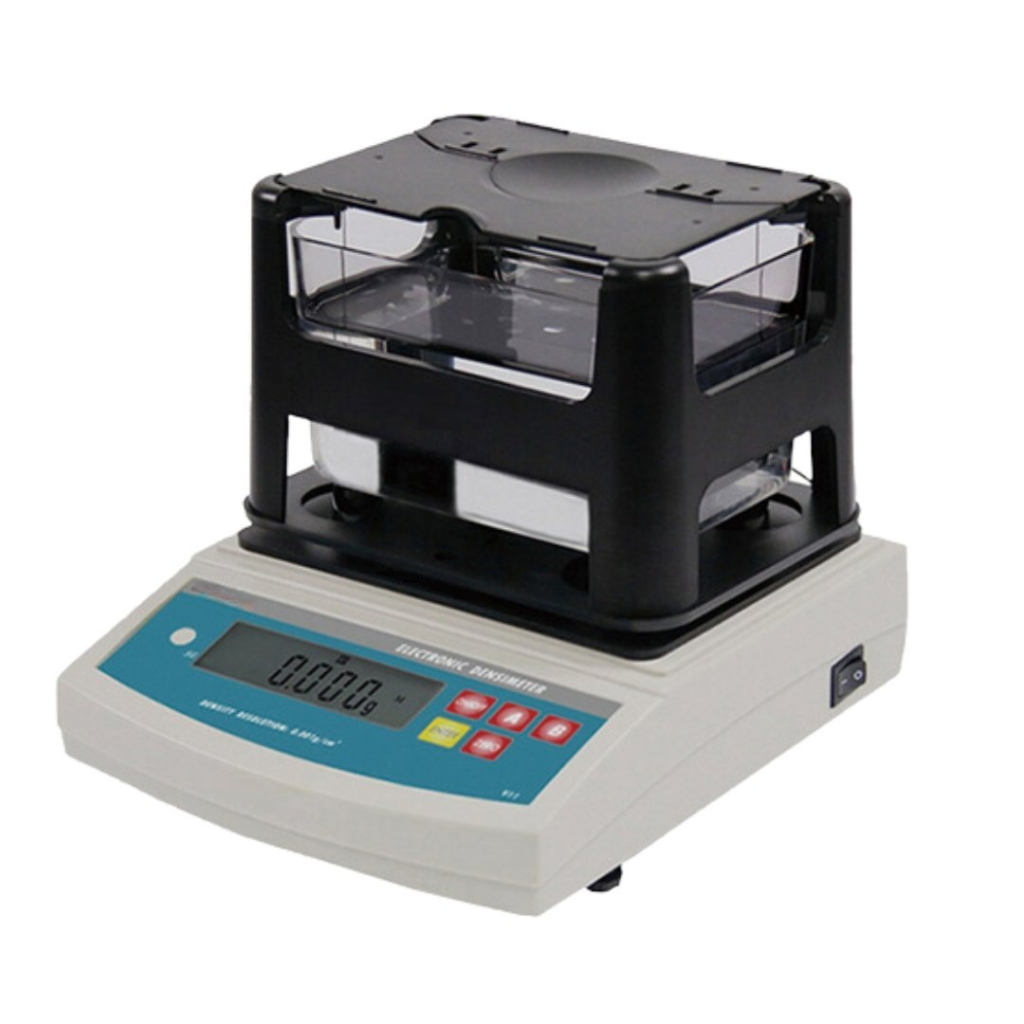
Densimeter
A high-precision Densimeter designed for accurate measurement of liquid and solid density. Ideal for laboratory, production QC, and research applications. Durable, reliable, and user-friendly for daily testing workflows.