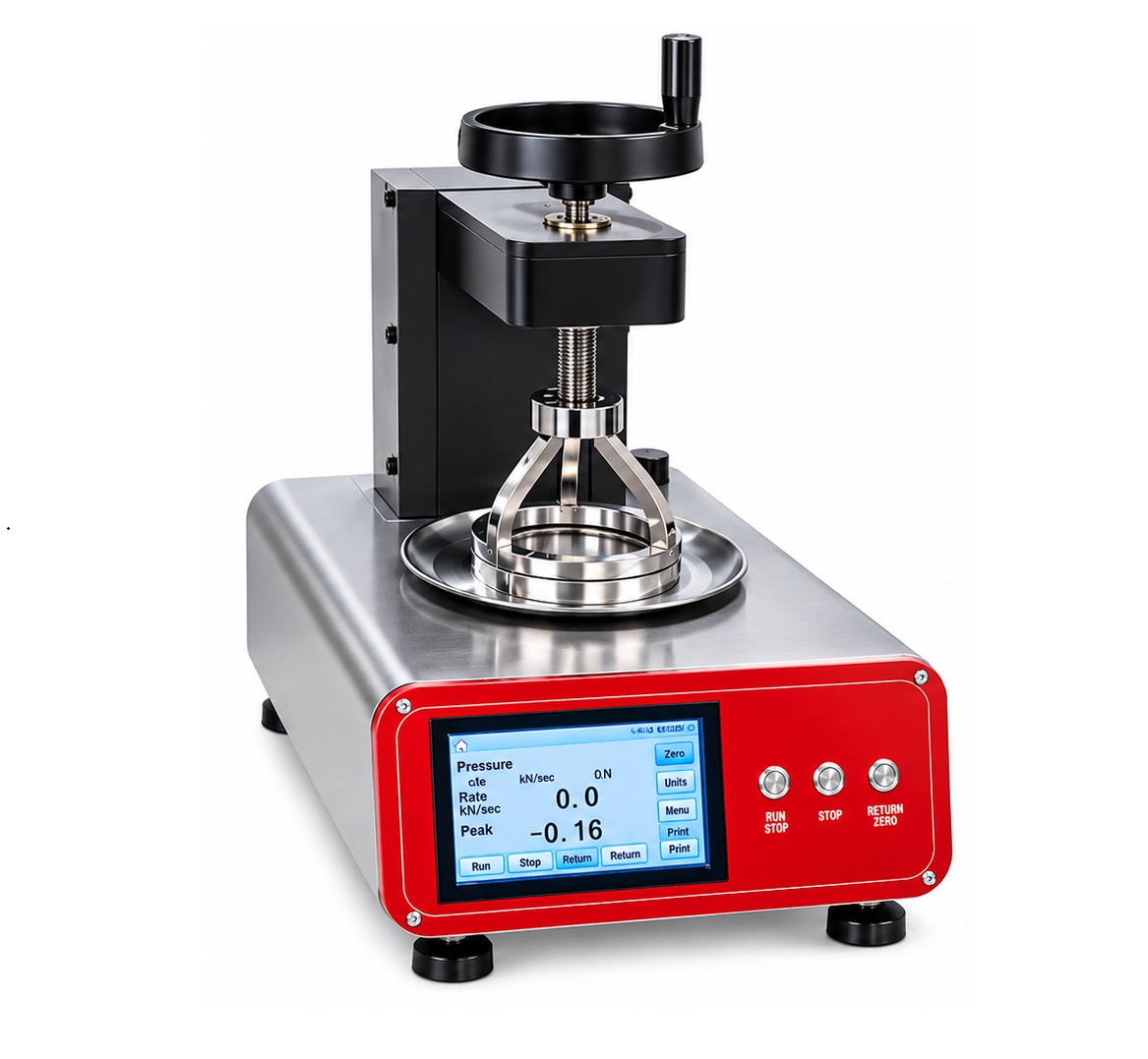
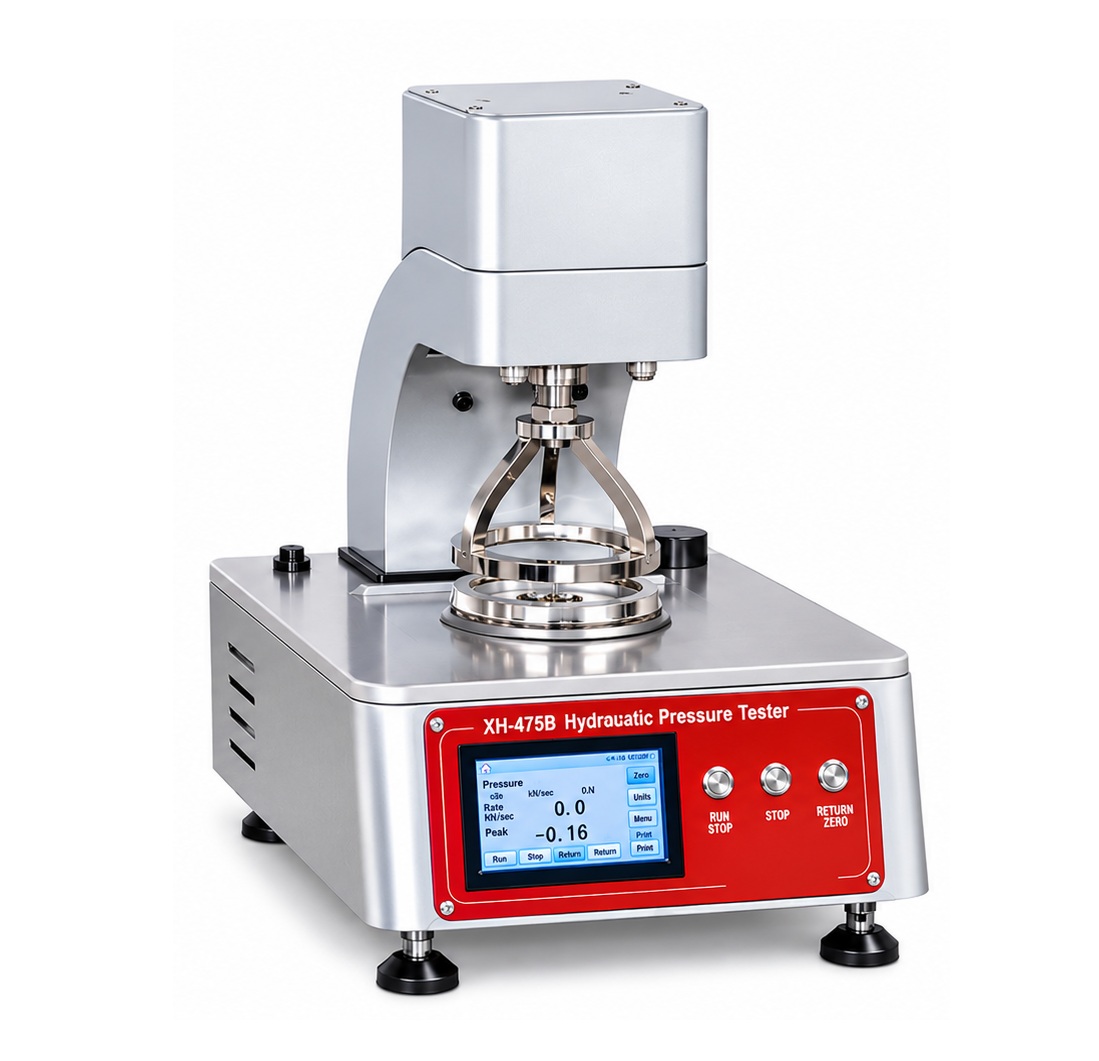
The Hydrostatic Head Pressure Tester is a textile testing instrument used to evaluate the water resistance and waterproof performance of fabrics and flexible materials.
The instrument works by applying water pressure to one side of a clamped test specimen. The pressure is gradually increased at a controlled rate until water penetrates through the material. The pressure at which water penetration occurs is recorded as the hydrostatic head pressure.
The test result indicates the ability of a material to resist water penetration under pressure. This is particularly important for manufacturers of waterproof clothing, rainwear, tents, outdoor equipment and protective fabrics.
The tester is suitable for evaluating untreated fabrics as well as materials with water-resistant coatings, laminations or waterproof finishes.
⭐ Key Features
- Accurate Pressure Measurement – Equipped with a pressure measurement system to monitor hydrostatic pressure during testing.
- Adjustable Pressure Rising Rate – Allows the water pressure increase rate to be adjusted according to the selected testing standard.
- Digital Control System – Provides convenient setting and monitoring of test parameters.
- Multiple Testing Modes – Supports dynamic pressure, constant pressure and other testing modes depending on the model.
- Clear Test Observation – Built-in LED illumination helps operators observe water penetration through the specimen.
- Secure Specimen Clamping – Designed to hold the test specimen firmly and minimise leakage around the clamping area.
- Multiple Pressure Units – Test results can be displayed in different pressure units, depending on the model.
- Automatic Test Operation – Microcomputer-controlled operation helps improve testing consistency and repeatability.
- Data Recording – Optional or built-in printing and data output functions are available depending on the selected configuration.
🏭 Applications
The Hydrostatic Head Pressure Tester is suitable for testing water resistance in various industries:
- Textile and garment manufacturing
- Waterproof clothing and rainwear production
- Outdoor apparel and sportswear manufacturing
- Tent and camping equipment production
- Footwear and shoe material manufacturing
- Protective clothing and workwear production
- Nonwoven fabric manufacturing
- Waterproof membrane and coated fabric production
- Quality control and textile testing laboratories
- Research and development laboratories
🧫 Materials Tested
- Woven fabrics
- Knitted fabrics
- Nonwoven fabrics
- Waterproof and water-resistant textiles
- PU-coated fabrics
- PVC-coated fabrics
- Laminated fabrics
- Tarpaulin materials
- Outdoor and rainwear fabrics
- Geotextiles (subject to suitable test configuration)
- Rubber-coated and plastic-coated fabrics
- Waterproof membrane materials
📚 Test Standards
The Hydrostatic Head Pressure Tester can be configured for testing according to the following international standards, depending on the selected test method and machine configuration.
| Standard | Test Description |
|---|---|
| ISO 811 | Textiles – Determination of resistance to water penetration – Hydrostatic pressure test |
| AATCC 127 | Water Resistance: Hydrostatic Pressure Test |
| BS EN 20811 | Textiles – Determination of resistance to water penetration – Hydrostatic pressure test |
| JIS L 1092 | Testing methods for water resistance of textiles |
| GB/T 4744 | Textiles – Testing and evaluation of water resistance – Hydrostatic pressure method |
| ISO 1420 | Rubber- or plastics-coated fabrics – Determination of resistance to penetration by water |
Note: The applicable standard depends on the material being tested and the required test procedure. ISO 811 and AATCC 127 are commonly used for fabric hydrostatic pressure testing. ISO 1420 is intended for rubber- or plastics-coated fabrics. Please confirm the required standard and test method before selecting the machine configuration.
⚙️ Technical Specifications
| Specification | Standard Configuration |
|---|---|
| Testing Principle | Hydrostatic water pressure method |
| Pressure Range | 0–200 kPa (model dependent) |
| Pressure Accuracy | ±0.5% (model dependent) |
| Pressure Resolution | 0.01 kPa (model dependent) |
| Pressure Rising Rate | 1–100 kPa/min, adjustable (model dependent) |
| Standard Test Area | 100 cm² |
| Test Method | Dynamic pressure / constant pressure (model dependent) |
| Control System | Microcomputer control |
| Display | Colour LCD touchscreen (model dependent) |
| Observation System | Built-in LED illumination |
| Pressure Units | Pa, kPa, mmH₂O, mmHg, cmH₂O, PSI or Bar (model dependent) |
| Data Output | Built-in printer / USB interface (model dependent) |
| Clamping System | Manual or pneumatic (model dependent) |
| Power Supply | AC 110 V / 220 V, 50/60 Hz (model dependent) |
📦 What’s Included
- Hydrostatic Head Pressure Tester main unit
- Standard test head (100 cm², model dependent)
- Specimen clamping assembly
- Water pressure generation system
- Digital control and measurement system
- Built-in LED illumination system (model dependent)
- Water reservoir or tank
- Power cable
- Operation manual
🔧 Options & Accessories
- Additional test heads with different testing areas
- Alternative specimen clamping fixtures
- Pneumatic clamping system (if not included in standard configuration)
- Additional pressure measurement ranges
- Built-in thermal printer
- USB data communication interface
- Computer connection and testing software
- Special testing fixtures for coated fabrics and other materials
- Air compressor (required for models equipped with pneumatic clamping)
📏 Sample Requirements
Test specimens should be prepared according to the applicable testing standard and selected test method.
| Parameter | Requirement |
|---|---|
| Sample Material | Woven, knitted, nonwoven or coated fabrics |
| Sample Shape | Flat specimen suitable for the test head |
| Sample Dimensions | Large enough to cover the clamping area |
| Test Area | Typically 100 cm², depending on the selected test head |
| Sample Surface | Clean, flat and free from visible damage |
| Sample Conditioning | According to the applicable testing standard |
Note: Specimen dimensions and conditioning requirements depend on the selected test standard. The specimen must be securely clamped to prevent water leakage around the edges during testing.
❓ Frequently Asked Questions (FAQs)
1. What is a Hydrostatic Head Pressure Tester used for?
It is used to measure the resistance of fabrics and flexible materials to water penetration under hydrostatic pressure. The result indicates how much water pressure the material can withstand before water passes through it.
2. What is hydrostatic head pressure?
Hydrostatic head pressure is the pressure exerted by a column of water on a material. In textile testing, it is used to evaluate the waterproof performance of fabrics. A higher hydrostatic pressure result generally indicates greater resistance to water penetration under the specified test conditions.
3. What materials can be tested?
The tester can be used for woven fabrics, knitted fabrics, nonwoven materials, PU-coated fabrics, PVC-coated fabrics, laminated textiles, tarpaulins and other suitable waterproof materials.
4. What is the difference between ISO 811 and AATCC 127?
Both standards evaluate the resistance of fabrics to water penetration under hydrostatic pressure. However, their test procedures and specified conditions may differ. The appropriate method should be selected according to customer requirements and the applicable product specification.
5. What does a higher hydrostatic head result mean?
A higher result generally means that the material can withstand greater water pressure before penetration occurs. This is an important performance indicator for waterproof clothing, tents, outdoor equipment and other water-resistant products.
6. Can the tester evaluate waterproof coatings?
Yes. It can evaluate the water penetration resistance of coated and laminated fabrics, provided the selected test method and fixture are suitable for the material.
7. What is the standard test area?
A 100 cm² test area is commonly used for hydrostatic pressure testing. Other test head sizes may be available as optional accessories, depending on the machine model and testing standard.
8. Can the machine perform constant pressure testing?
Some models provide constant pressure and fixed-time testing modes in addition to the pressure-rising method. Available functions depend on the selected machine configuration.