
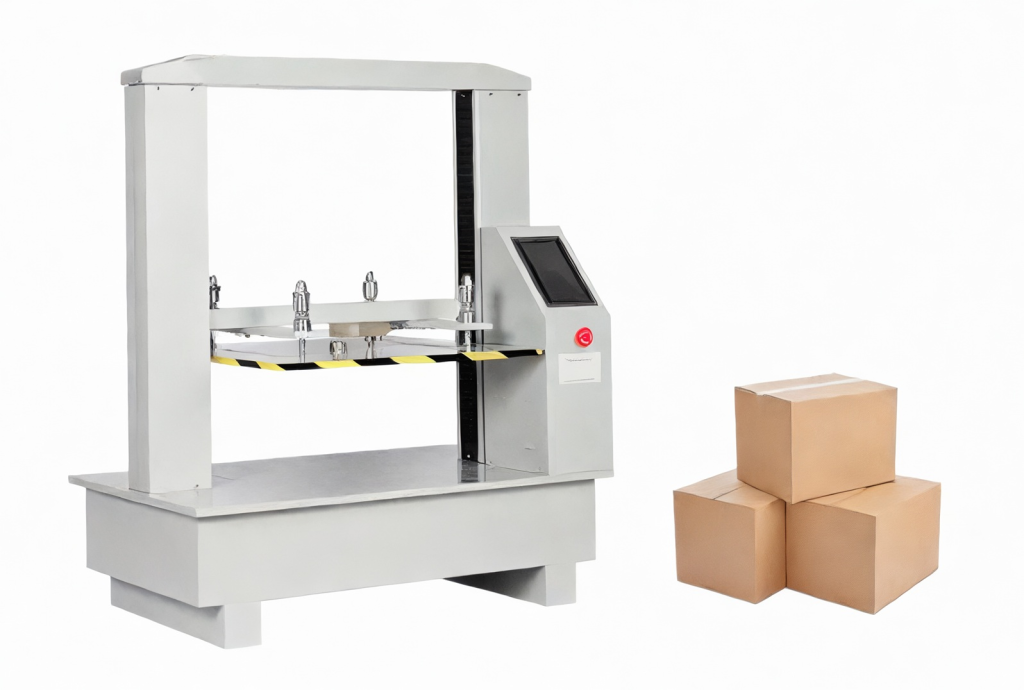
Packaging plays an important role in protecting products during storage, transportation, and distribution. Corrugated cartons and cardboard boxes must withstand stacking pressure, handling forces, and environmental conditions without collapsing or damaging the contents.
To ensure packaging can withstand these conditions, manufacturers use a laboratory instrument called a Box Compression Tester (BCT).
This article explains what a Box Compression Tester is, how it works, its applications, and why compression testing is essential for packaging quality control.
📘 1. What Is a Box Compression Tester?
A Box Compression Tester is a laboratory testing machine used to measure the maximum compressive force that a box, carton, or other packaging container can withstand before deformation or failure.
During testing, a packaging sample is placed between two parallel compression plates. The machine gradually applies a compressive load until the box reaches its specified deformation or collapses.
The maximum force recorded is known as the Box Compression Strength (BCT).
The test helps manufacturers evaluate packaging strength and determine whether cartons can withstand stacking loads during storage and transportation.
📦 2. Why Is Box Compression Testing Important?
During warehousing and transportation, packaging is frequently subjected to vertical compression forces.
For example:
Cartons stacked several layers high in warehouses.
Packaging compressed inside shipping containers.
Boxes subjected to pressure during pallet stacking.
Products transported over long distances.
Packaging exposed to different temperature and humidity conditions.
Insufficient box compression strength can result in:
Carton deformation or collapse.
Damage to products inside the packaging.
Reduced stacking stability.
Increased transportation and storage losses.
Customer complaints and product rejection.
A Box Compression Tester helps manufacturers identify packaging weaknesses before products enter the supply chain.
⚙️ 3. How Does a Box Compression Tester Work?
Testing Procedure
Prepare the Sample: Select a representative corrugated box or carton according to the applicable testing standard.
Position the Sample: Place the box centrally between the upper and lower compression plates.
Set Test Parameters: Configure the compression speed and other test parameters according to the selected standard.
Start the Test: The compression plate moves downward and gradually applies force to the box.
Record the Result: The machine continuously measures the applied force and displacement.
Determine Compression Strength: Record the maximum compressive force reached before the box fails or the test reaches its specified endpoint.
The results are typically expressed in Newtons (N) or kilonewtons (kN).
📊 4. What Is Box Compression Strength (BCT)?
Box Compression Strength, commonly abbreviated as BCT, refers to the maximum compressive load a complete box can withstand before failure under specified testing conditions.
For example:
If a corrugated carton withstands a maximum compressive force of 5,000 N before collapsing, its measured box compression strength is 5,000 N.
BCT results are influenced by several factors:
Corrugated board thickness and flute structure.
Paper liner and medium strength.
Box dimensions and design.
Joint and sealing quality.
Moisture content and environmental humidity.
Storage and conditioning conditions.
Important: A higher BCT value generally indicates greater compression resistance, but actual stacking performance also depends on packaging design, storage conditions, and safety factors.
🏭 5. Industries That Use Box Compression Testers
Box Compression Testers are widely used in industries that rely on corrugated cartons and protective packaging.
Common Applications
1. Corrugated Carton Manufacturing
Evaluate the compression strength of corrugated boxes before delivery to customers.
2. Food & Beverage Packaging
Ensure cartons can withstand stacking during storage and distribution of packaged food and beverages.
3. E-commerce & Logistics
Evaluate shipping boxes to reduce packaging failures during handling and transportation.
4. Pharmaceutical Packaging
Assess the mechanical strength of secondary packaging cartons used for pharmaceutical products.
5. Electronics & Electrical Products
Ensure packaging provides sufficient structural strength to protect electronic equipment.
6. Consumer Goods Manufacturing
Evaluate packaging performance for household products, personal care products, and other consumer goods.
🧪 6. Box Compression Test vs. Edge Crush Test (ECT)
Both Box Compression Testing and Edge Crush Testing are important methods for evaluating corrugated packaging strength. However, they measure different properties.
Comparison | Box Compression Test | Edge Crush Test |
|---|---|---|
Test sample | Complete box | Corrugated board specimen |
Measurement | Overall box compression strength | Edgewise compressive strength |
Main purpose | Evaluate box stacking resistance | Evaluate corrugated board strength |
Result | N or kN | kN/m or lb/in |
Application | Finished packaging | Board material quality control |
Which test should manufacturers choose?
Choose BCT when evaluating the overall compression performance of finished cartons.
Choose ECT when evaluating the compressive strength of corrugated board before box production.
Both tests provide valuable information and are often used together in packaging quality control.
📐 7. International Standards for Box Compression Testing
Box Compression Testing is associated with several international testing standards.
Standard | Description |
|---|---|
ISO 12048 | Packaging — Complete, filled transport packages — Compression and stacking tests |
ASTM D642 | Standard Test Method for Determining Compressive Resistance of Shipping Containers, Components, and Unit Loads |
TAPPI T804 | Compression Test of Fiberboard Shipping Containers |
The appropriate standard depends on the packaging type, testing requirements, and whether the test is performed on an empty container, filled package, or packaging components.
Always verify the latest applicable standard and its specific testing requirements before conducting a test.
🔍 8. Factors to Consider When Selecting a Box Compression Tester
When choosing a Box Compression Tester for a laboratory or production facility, consider the following factors:
1. Load Capacity
Select a machine with sufficient maximum compression force to accommodate the expected strength of your packaging samples.
2. Compression Plate Size
Ensure the compression plates can accommodate the largest carton or packaging sample you intend to test.
3. Load Cell Accuracy
Accurate force measurement is essential for obtaining reliable and repeatable test results.
4. Testing Speed
The machine should provide adjustable compression speed to meet the requirements of the applicable testing standard.
5. Displacement Measurement
Displacement measurement helps monitor carton deformation during compression.
6. Data Recording & Software
Consider models with digital displays, automatic peak-force recording, test curves, and data export capabilities.
7. Safety Features
Safety protection and emergency stop functions help protect operators during testing.
⭐ 9. Benefits of Using a Box Compression Tester
A Box Compression Tester provides several advantages for packaging manufacturers and quality control laboratories.
Improves Packaging Quality: Ensures cartons meet specified compression strength requirements.
Reduces Product Damage: Helps prevent carton collapse during storage and transportation.
Optimizes Packaging Design: Supports the development of stronger and more cost-effective packaging.
- Maintains Quality Consistency: Allows manufacturers to compare compression strength between production batches.
- Reduces Material Waste: Helps identify packaging weaknesses before large-scale production.
- Supports Customer Requirements: Provides measurable test results for packaging quality verification.
📝10. Frequently Asked Quations (FAQs)
Q1: What does a Box Compression Tester measure?
It measures the maximum compressive force that a complete box or packaging container can withstand before failure or a specified test endpoint.
Q2: What is the difference between BCT and ECT?
BCT measures the compression strength of a complete box, while ECT measures the edgewise compressive strength of corrugated board material.
Q3: What unit is used for Box Compression Strength?
The results are commonly expressed in Newtons (N) or kilonewtons (kN).
Q4: Can a Box Compression Tester test plastic containers?
Yes. Depending on the machine design, compression testers can also evaluate plastic containers, drums, and other packaging structures. Appropriate fixtures and testing procedures may be required.
Q5: Does humidity affect box compression strength?
Yes. Corrugated packaging is sensitive to moisture. Higher humidity can reduce paperboard stiffness and compression resistance, potentially resulting in lower BCT values.
Q6: Is Box Compression Testing a destructive test?
Generally, yes. The test normally continues until the packaging deforms significantly or collapses, although certain tests may use a predefined load or deformation endpoint
🎯 Conclusion
A Box Compression Tester is an essential testing instrument for evaluating the structural strength and stacking performance of corrugated cartons and packaging containers.
By measuring the maximum compressive force that packaging can withstand, manufacturers can improve packaging design, maintain product quality, reduce transportation damage, and ensure packaging meets customer and industry requirements.
For packaging manufacturers, paper mills, and quality control laboratories, investing in reliable compression testing equipment is an important step towards achieving consistent packaging performance.
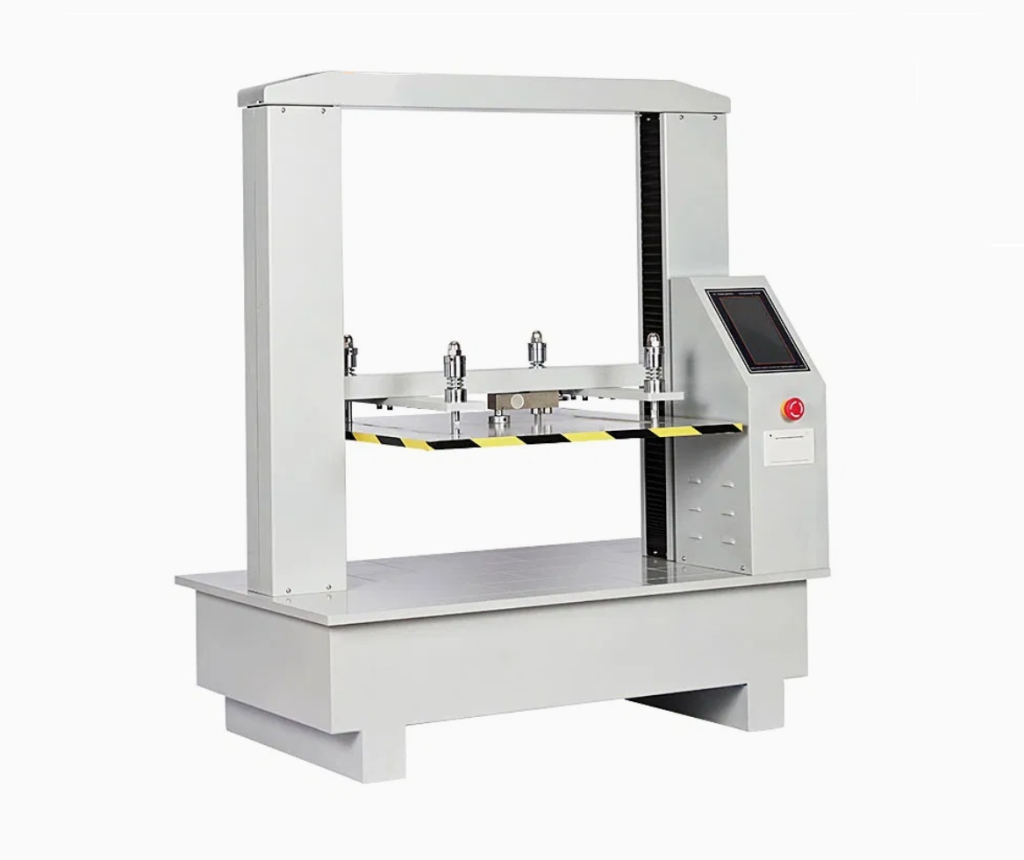
Box Compression Tester
High-strength Carton Box Compression Tester designed to measure the compressive resistance of corrugated boxes and packaging containers. Ideal for packaging manufacturers, QC labs, and logistics industries. Features digital force display, programmable test modes, and compliance with ISO 12048, ASTM D642, and TAPPI T804 standards.