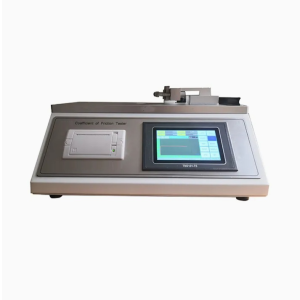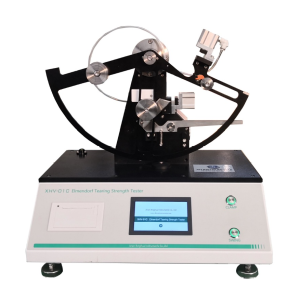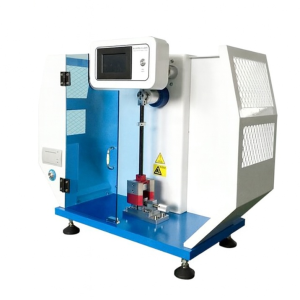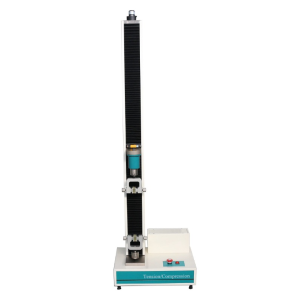
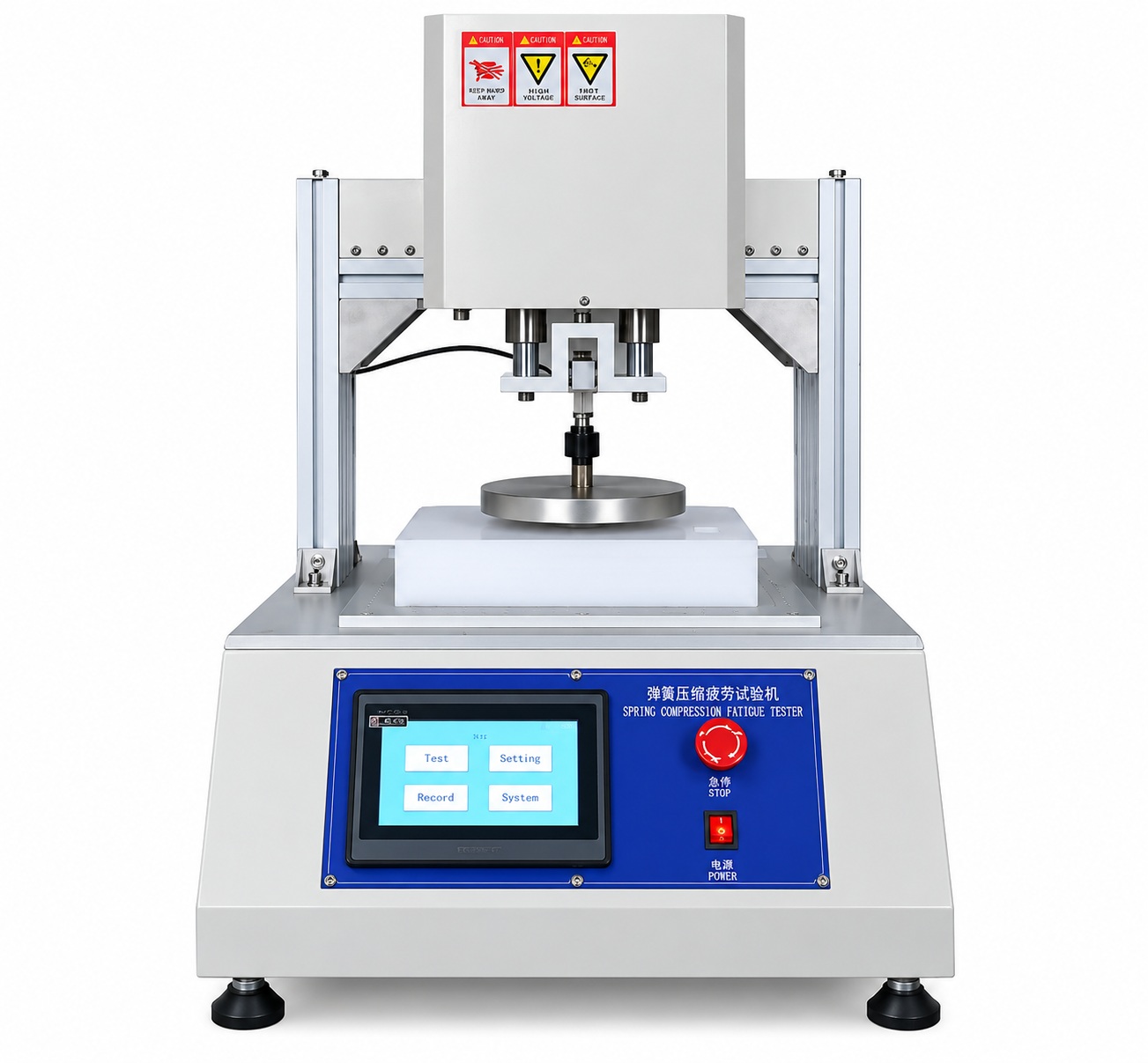
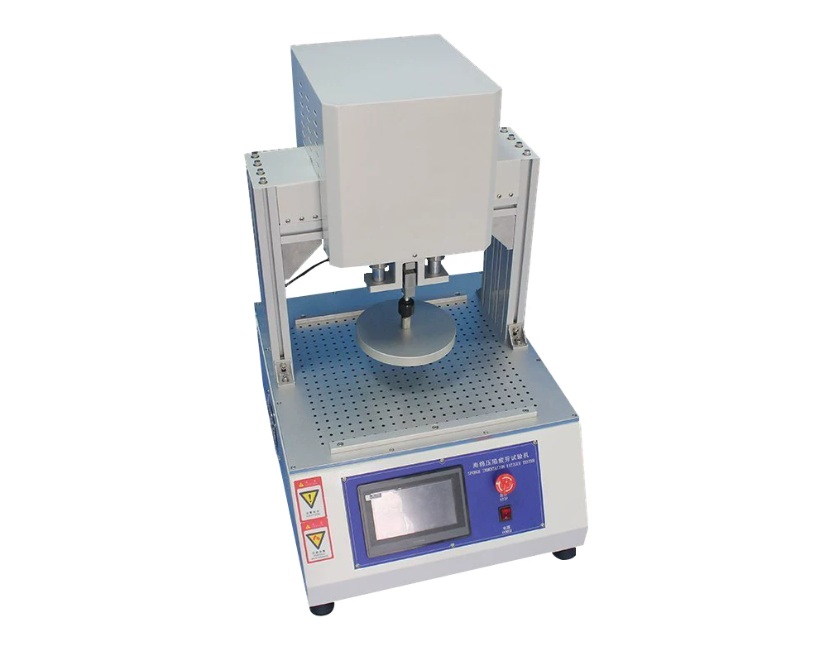
The Foam Compression Tester is a material testing instrument used to evaluate the resistance of foam materials to compressive forces. It measures the force required to compress a specimen and the resulting deformation, helping manufacturers assess foam hardness, compression performance and material consistency.
The tester operates by applying a controlled compressive force through a moving compression plate or specified indenter. Force and displacement measurements are recorded during the test to evaluate the mechanical properties of the material.
Depending on the machine configuration, testing fixtures and selected test method, the instrument can be used for indentation hardness testing and compression stress-strain evaluation of flexible cellular materials.
⭐ Key Features
- Accurate Force Measurement – Measures the compressive force applied to foam specimens.
- Displacement Measurement – Monitors specimen deformation during compression.
- Adjustable Test Speed – Allows test speed to be configured according to testing requirements.
- Digital Control System – Provides convenient operation and monitoring of test parameters.
- Multiple Testing Applications – Suitable for different foam compression tests with the appropriate fixtures.
- User-Friendly Operation – Simplifies testing procedures and result monitoring.
- Flexible Configuration – Different load capacities and testing accessories can be selected according to application requirements.
- Quality Control Support – Helps evaluate material consistency between production batches.
🏭 Applications
The Foam Compression Tester is suitable for quality control and material evaluation in various industries:
- Foam manufacturing and processing
- Mattress and bedding production
- Furniture and upholstery manufacturing
- Automotive seat and interior component production
- Packaging foam manufacturing
- Rubber and cellular material production
- Research and development laboratories
- Quality control and inspection laboratories
🧫 Materials Tested
- Flexible polyurethane (PU) foam
- High-resilience (HR) foam
- Memory foam
- Latex foam
- Rebonded foam
- EVA foam
- Sponge and cellular rubber
- Other suitable flexible cellular materials
📚 Test Standards
The Foam Compression Tester can be configured for testing according to relevant international standards, depending on the selected test method and accessories.
| Standard | Test Description |
|---|---|
| ISO 2439 | Flexible cellular polymeric materials – Determination of hardness (indentation technique) |
| ISO 3386-1 | Flexible cellular polymeric materials – Determination of compression stress-strain characteristics |
| ASTM D3574 | Standard test methods for flexible cellular materials – Slab, bonded and molded urethane foams |
| ASTM D1056 | Standard specification for flexible cellular materials – Sponge or expanded rubber |
Note: The applicable standard depends on the material, test method and machine configuration. Different testing methods may require specific compression plates, indenters, fixtures and specimen dimensions. Compression set testing is a separate test and requires an appropriate fixture and conditioning procedure.
⚙️ Technical Specifications
| Specification | Standard Configuration |
|---|---|
| Testing Type | Foam compression / indentation testing |
| Load Capacity | 500 N / 1 kN / 2 kN (model dependent) |
| Force Measurement Accuracy | ±1% (model dependent) |
| Displacement Resolution | 0.01 mm (model dependent) |
| Test Speed | Adjustable |
| Compression Method | Motor-driven compression |
| Compression Plate | Flat compression plate or specified indenter |
| Control System | Digital control system |
| Display | LCD / touchscreen (model dependent) |
| Data Output | Digital test result display |
| Communication Interface | USB / RS232 (optional, model dependent) |
| Power Supply | 220 V, 50/60 Hz (model dependent) |
Note: The specifications above are indicative and may vary according to the selected model and configuration.
📦 What’s Included
- Foam Compression Tester main unit
- Standard compression plate or testing fixture
- Digital control and measurement system
- Specimen positioning accessories (model dependent)
- Power cable
- Operation manual
🔧 Options & Accessories
- Additional compression plates and indenters
- Different load cells to suit testing requirements
- Special specimen holding fixtures
- Compression set testing fixture (if supported by the selected model)
- Data acquisition software
- USB / RS232 communication interface
- Computer and printer connection
- Customised testing fixtures
📏 Sample Requirements
Foam specimens should be prepared according to the applicable testing standard and selected test method.
| Parameter | Requirement |
|---|---|
| Sample Material | Flexible foam or other suitable cellular materials |
| Sample Shape | Square or circular, depending on test method |
| Sample Dimensions | According to the applicable testing standard |
| Sample Thickness | According to the selected test method |
| Sample Surface | Flat, clean and free from visible defects |
| Sample Conditioning | According to the relevant testing standard |
Note: Specimen dimensions, thickness and conditioning requirements differ between indentation hardness, compression stress-strain and compression set testing.
❓ Frequently Asked Questions (FAQs)
1. What is a Foam Compression Tester used for?
A Foam Compression Tester is used to evaluate the compression properties of foam materials, including indentation hardness, compression force and deformation characteristics.
2. What types of foam can be tested?
It can be used for flexible PU foam, memory foam, latex foam, HR foam, rebonded foam, EVA foam and other suitable cellular materials, depending on the machine configuration.
3. Can this machine measure foam hardness?
Yes. When configured with the appropriate indenter and testing procedure, the tester can perform indentation hardness testing according to standards such as ISO 2439.
4. Can it perform compression stress-strain testing?
Yes. With the appropriate compression plates, load measurement range and test procedure, the tester can be configured for compression stress-strain testing according to ISO 3386-1.
5. Can it perform compression set testing?
Compression set testing requires a specific fixture and specimen conditioning procedure. Please confirm this requirement when selecting the machine to ensure the correct configuration is supplied.
6. Can the machine connect to a computer?
USB, RS232 or data acquisition software may be available depending on the selected model.
7. Can the load capacity be customised?
Different load capacities may be available depending on the model. The suitable capacity should be selected according to the expected compression force and testing requirements.